Framing Fringes
Reading the periphery
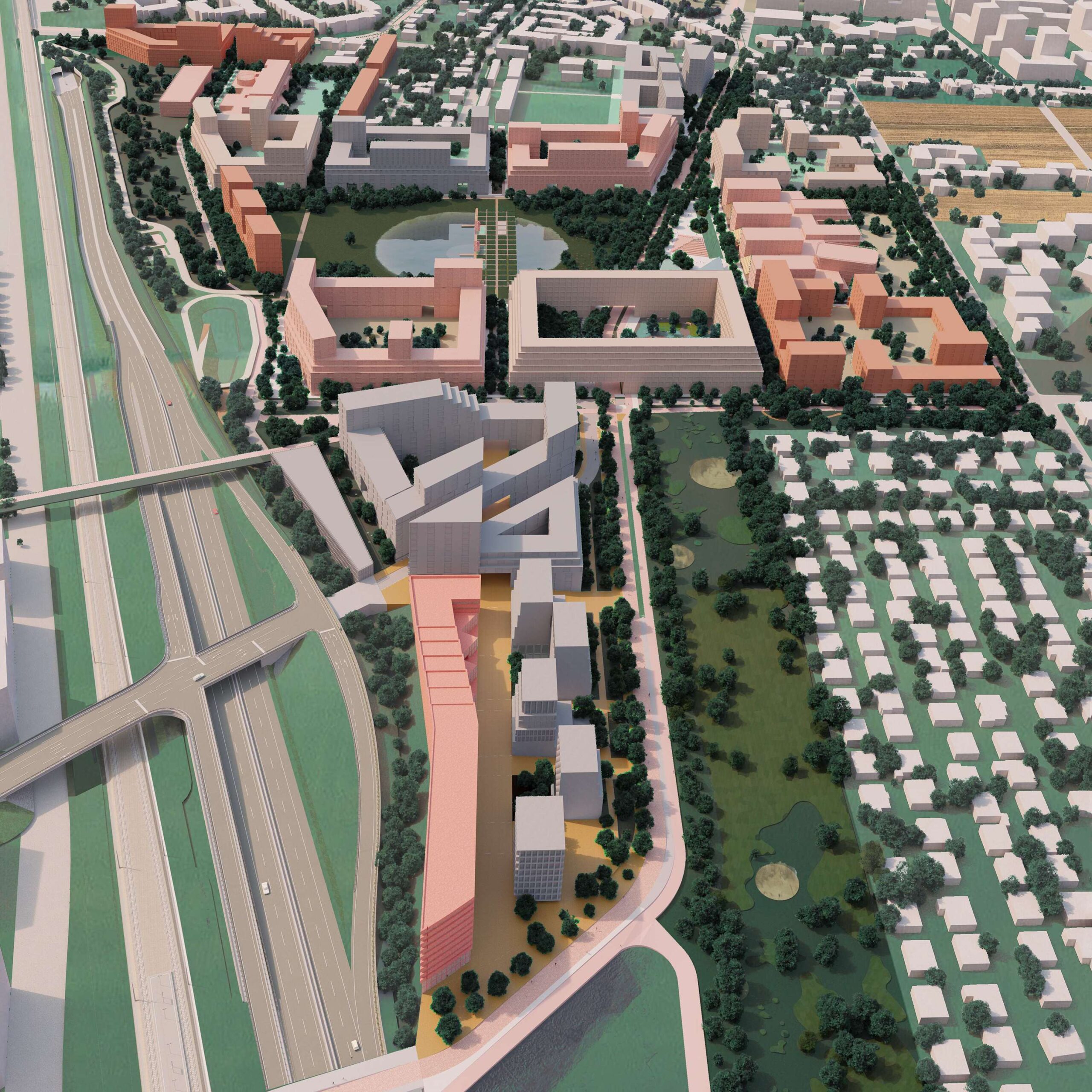
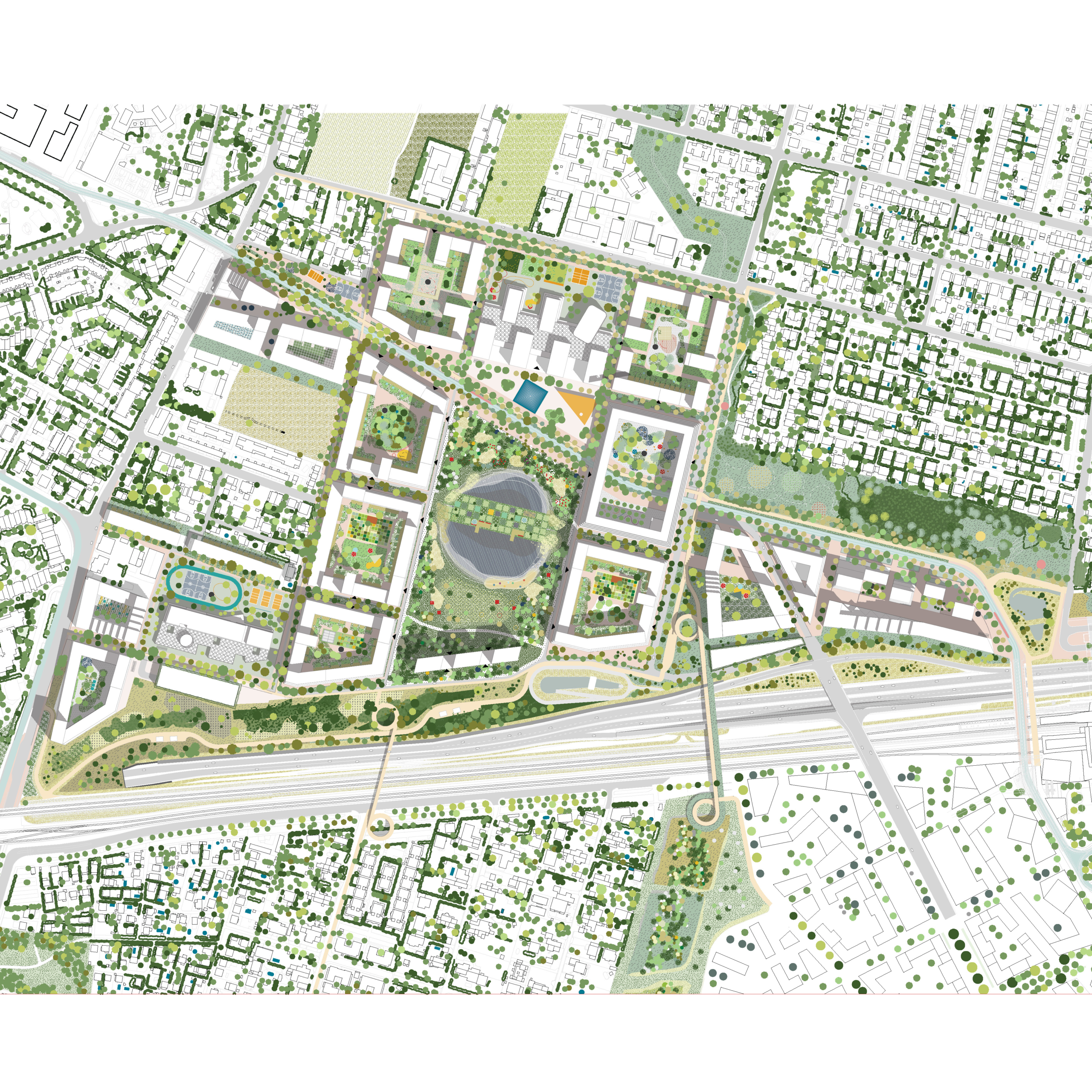
The main goal of our proposal for the new Am Heidjöchl quarter is to insert a sober and recognisable urban ensemble into the heterogenous metropolitan field of Donaustadt, and to preserve the quality and scale of the expansive open spaces that define the spatial experience of this treshold location on the eastern edge of Vienna. While acknowledging all the reasonable criticism concerning the sprawling peripheries of our large cities, we intended to treat their scale, complexity and patchwork-like structure as resources to work with. The expanding urban landscape of Donaustadt is characteristically a part of the ever growing “even covered field” of global urbanization, and thus appears as a large, kaleidoscopic collection of fundamentally different settlements and spatial arrangements, often based on conflicting or contradictory ideas on desirable city-life and corresponding city-form. However, while navigating through and reflecting on the Viennese periphery one can observe certain local tendencies that make the condition and imaginable futures of these splintering urbs more hopeful. First, the ambitious investment in, and strategic buildout of public transportation gives more spatial coherence and legibility to the urban system even in the abscence of clear forms. Cycling or riding at different speeds and looking through different perspectives on the U-Bahn or the tram, one can experience the multiplicity of the outer districts more so as an exciting sequence rather than a disorienting chaos. Second, the robust institutional and architectural tradition of Viennese planning culture enables experimental possibilities that are scarcer elsewhere. The needs of the growing city and its peculiar planning methods resulted in the implementation of interesting typological hybrids, and cross-fertilization between the diverging settlement configurations. This mixture of a robust collective infrastructure and the synthetic re-interpretation and hybridization of inherited typologies could be used as a good starting point for imagining the future, without resorting to empty utopianism or a self-defeating nostalgia towards the more coherent form of a lost “historical” city. We imagine the coming city as a multitude of forms and choices united by a universally common framework.
Year
2023
Location
Vienna, AT
Type
Urban design
Status
Europan Competition
Surface
– sqm
Client
–
Collaborator(s)
Kovács Júlia, Madácsi Flóra, Winkler Márk Gergely, Frey Martin